Virolahti possesses a biodiversity hotspot

This became clear when a comprehensive analysis of the nature and species data of Kymenlaakso and South Karelia was carried out last spring. The Priodiversity LIFE project team of the Southeastern Finland Centre for Economic Development, Transport and the Environment, together with project partners and stakeholders, identified a total of 18 biodiversity hotspots in the two provinces. In South Karelia, these hotspots include, for example, the Parikkala grove district around Siikalahti and the Hiitolanjoki with its wild headwaters. In Kymenlaakso, the hotspots emphasize protected mires, but also the outskirts of cities in Kouvola, Kotka and Hamina.

Biodiversity hotspots are areas where the diversity of habitat types and even the most demanding species characteristic of the region is at its highest. Nature in Kymenlaakso has largely been heavily modified: over 80 percent of the mires have been drained, old forests remain in small fragments, and the condition of small bodies of water is poor. However, the preserved natural gems include the extensive mires, the Repovesi National Park, and the diverse archipelago and marine area.
According to a study conducted by the Finnish Environment Institute in 2024, the most noteworthy species in the region currently live in environments that have been largely influenced by humans, such as road verges, airfields and all sorts of wasteland. Altogether 137 species were named “under the responsibility of Kymenlaakso”, since the occurrences in the region are particularly significant for their conservation. These species are especially prominent in traditional and cultural environments.
They also contributed to making Virolahti one of the biodiversity hotspots of Kymenlaakso. The area, which is located around the villages of kirkonkylä and Hanski, measures approximately 10 x 20 kilometres, and stretches from the northern bay of Virolahti to the limits of eastern Gulf of Finland National Park and to the outer archipelago. So far, about 330 hectares of nature have been protected in this area – less than two percent of the area of the biodiversity hotspot.
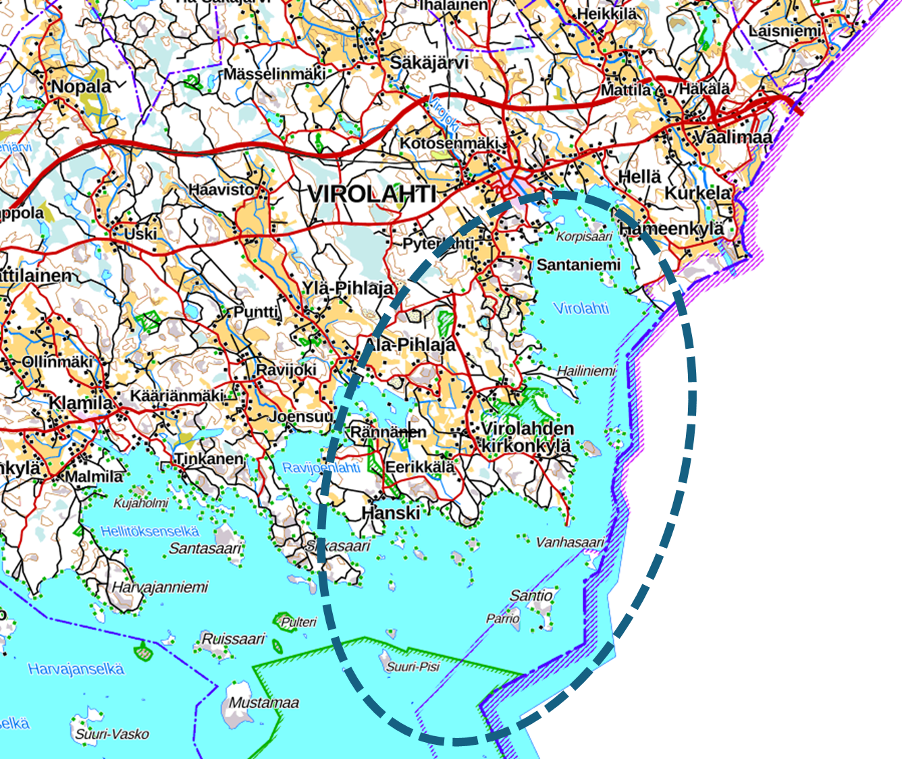
The hotspot was unofficially named “Bird highway”, as Virolahti is one of the most suitable places in Finland to observe the mass migration of Arctic birds. Kirkontura-Vilkkiläntura is a shallow bay that is an exceptionally valuable resting area for waterfowl. The breeding birdlife is also diverse, with its waders and reed species.

The area has the highest number of endangered species (184) of any hotspot in Kymenlaakso. Among them, there are many tiny moths that are especially found in drier environments, such as four extremely endangered species. In fact, there is the highest number of endangered butterflies and moths of all the hotspots in southeastern Finland, which is a perfect fit for the home corner of Ilkka Hanski Nature Network!
The important habitat types of the Virolahti hotspot were defined as the marine sandy beaches and reed beds, specially named “tura” – which means the thick reed bed on the seashore in the Virolahti region. And their demanding species are not limited to six-legged insects. There are many rare birds and the only recent observation of the extremely endangered eel in southeastern Finland was also in the Virolahti area.

The Priodiversity LIFE project, which will continue until 2031, will draw up a biodiversity implementation plan for Kymenlaakso and seven other project counties – in short, the LUMO programme, which is framed by international and national agreements and strategies. The programmes bring higher-level strategies to the provincial level and biodiversity promotion measures into practice. The draft of the LUMO programme will be completed this year and the final programme during 2027.
What are the biodiversity hotspots framed for the programme then needed for? They can be used to target restoration, nature management and other voluntary nature conservation activities to the most valuable sites in the provinces. As the project progresses, work will also continue by identifying connections between the hotspots and biodiversity networks.
Ilkka Hanski Nature Network has already set a model for others. Hallinsuo, which is part of the network and protected in its northern parts, was restored last autumn with support from the HELMI programme granted by the local ELY Centre. Old ditches were filled in and a collecting ditch was restored to a stream. The work will enable the recovery of the mire vegetation and the return of the mire towards its natural state.
In the coming project years, Priodiversity will also be strongly established in the regions of Southeast Finland. Practical measures are needed to curb nature loss: mowing reed beds with birdbaths, revitalizing meadow management, or clearing spruce-infested groves. Landowners interested in nature management are also needed! Nature management and restoration measures will be implemented in cooperation with the South-Eastern Economic Development Centre, which will start operating in early 2026, Metsähallitus Nature Services and Metsähallitus Forestry Ltd.
Kimmo Saarinen
Kimmo works as a nature information specialist in the Priodiversity LIFE project team in the Southeastern Finland Centre for Economic Development, Transport and the Environment.


Comments